Our research in the field of human-robot interaction includes the development of modern interfaces for monitoring and controlling complex systems. This includes human-robot interaction in the form of a teleoperation system for mobile robots (robot boats and delivery robots) using VR/AR technologies as well as multi-modal interfaces in autonomous driving. These technologies are also used to provide modern traffic control systems, e.g. to support air traffic controllers.
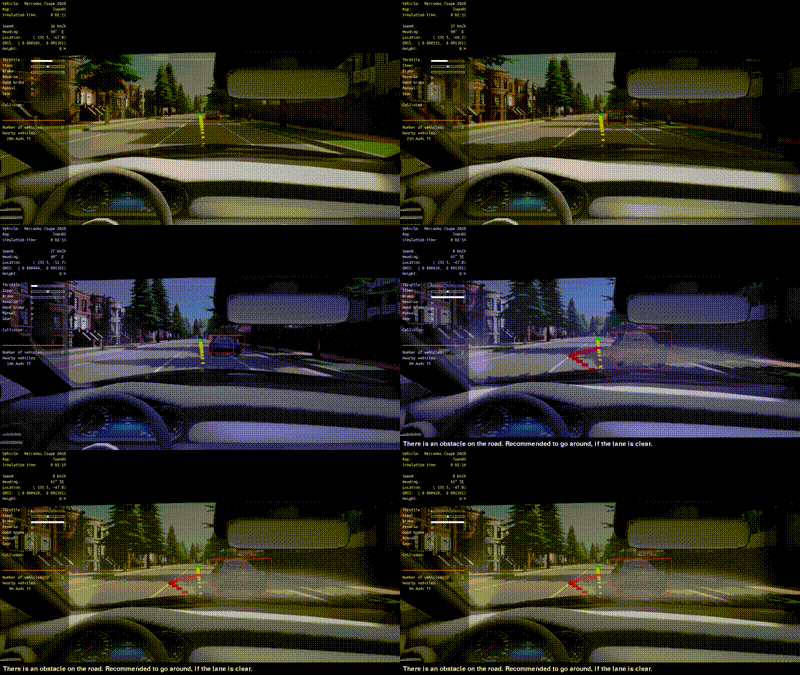
ADAS simulation for conflict situations in semi-autonomous driving (SAE level 3).
Our research specifically aims to improve the situational awareness of operators of autonomous systems (especially autonomous cars) in order to solve complex situations in which the system has to hand over control to the operator. This is done with the help of AI-based approaches and multimodal interfaces.
Our machine learning research focuses on data-driven methods for analyzing complex, often high-dimensional datasets - for example, terrestrial point clouds in geophysical exploration or time-series based air traffic forecasting. We combine supervised learning, deep learning, and hybrid approaches (e.g., LSTMs with evolutionary algorithms) to model and interpret patterns, anomalies, and temporal dynamics. A key focus is the development of model-driven ML pipelines that integrate heterogeneous data sources and enable automated reasoning - including the extraction of physically grounded prediction models from neural networks.
Many application domains lack sufficient annotated depth sensor data for training modern AI systems. To address this gap, we develop methods for the automated generation of synthetic 3D data in virtual environments. Using game engines and custom tools like BlAInder, we create realistic, semantically annotated point clouds for sensors such as LiDAR and Sonar - including complex environmental effects like rain, fog, or underwater physics. These virtual sensors enable scalable, controlled, and repeatable data generation for AI development in areas like robotics, autonomous driving, and geophysics.
 Stefan Reitmann